
Resources · 5K Training Plans
Intermediate 5K Training Plan
This plan is designed for runners who already have a steady base and want to gently improve their 5 km time, without tipping into burnout or injury.
It adds a bit more structure than a beginner plan, but the same principles still apply: consistency over perfection, listening to your body, and adjusting when life gets in the way.
Most runs in this plan should still feel controlled and sustainable. Easy and long runs are done at a pace where you could comfortably hold a conversation. Harder sessions have a purpose, but they’re never meant to leave you exhausted for days afterwards.
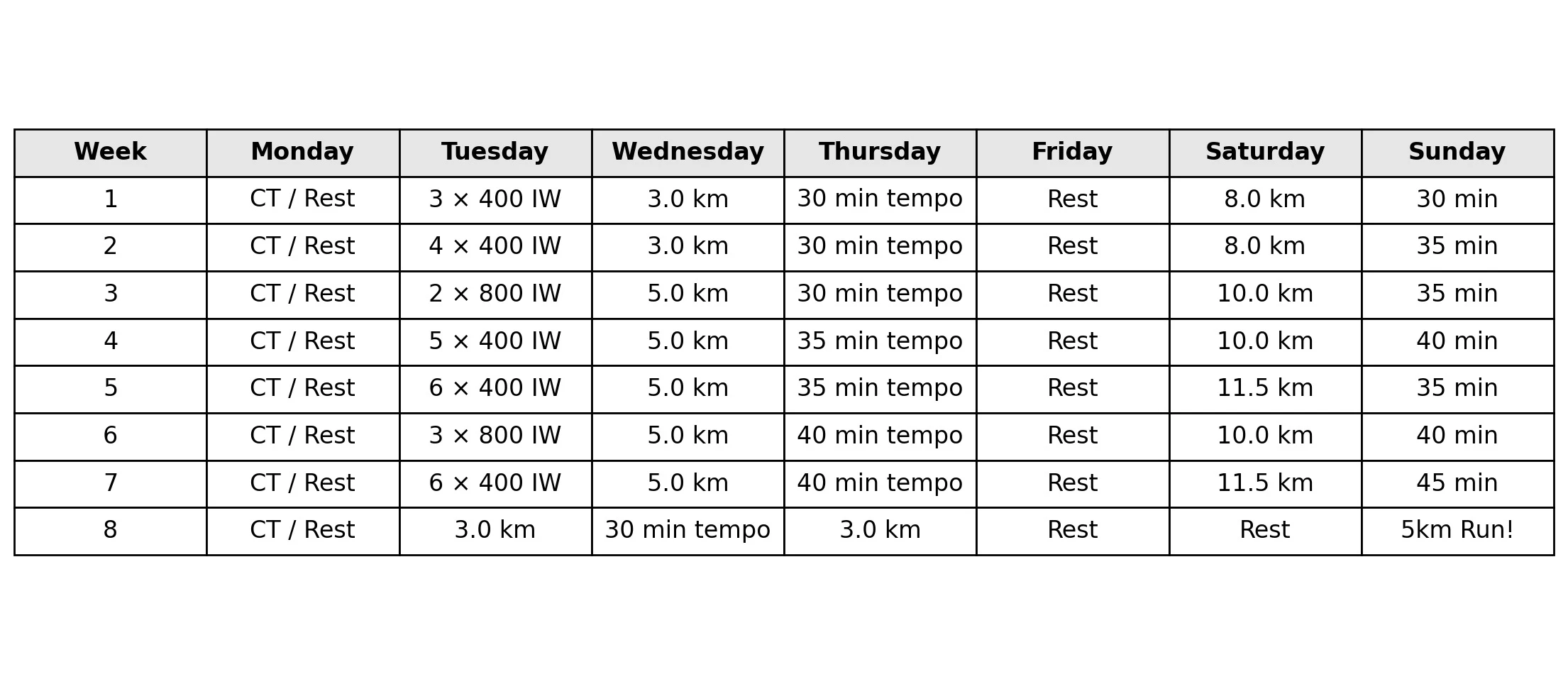
Read the schedule as text
| Week | Monday | Tuesday | Wednesday | Thursday | Friday | Saturday | Sunday |
|---|---|---|---|---|---|---|---|
| 1 | CT / Rest | 3 × 400 IW | 3.0 km | 30 min tempo | Rest | 8.0 km | 30 min |
| 2 | CT / Rest | 4 × 400 IW | 3.0 km | 30 min tempo | Rest | 8.0 km | 35 min |
| 3 | CT / Rest | 2 × 800 IW | 5.0 km | 30 min tempo | Rest | 10.0 km | 35 min |
| 4 | CT / Rest | 5 × 400 IW | 5.0 km | 35 min tempo | Rest | 10.0 km | 40 min |
| 5 | CT / Rest | 6 × 400 IW | 5.0 km | 35 min tempo | Rest | 11.5 km | 35 min |
| 6 | CT / Rest | 3 × 800 IW | 5.0 km | 40 min tempo | Rest | 10.0 km | 40 min |
| 7 | CT / Rest | 6 × 400 IW | 5.0 km | 40 min tempo | Rest | 11.5 km | 45 min |
| 8 | CT / Rest | 3.0 km | 30 min tempo | 3.0 km | Rest | Rest | 5km Run! |
Tempo runs
Tempo runs help you get used to running at a slightly stronger, more focused effort, which is useful for 5 km improvement.
Start each tempo run with 5–10 minutes of easy running, then move into a “comfortably hard” pace for the main part of the session. This should feel challenging but controlled, not like an all-out race. You should finish with 5–10 minutes easy to cool down.
If you’re unsure about pacing, a good rule of thumb is this: you’re working harder than an easy run, but you could still speak in short sentences if you needed to.
Interval workouts (IW)
Interval sessions are there to build strength, confidence, and efficiency, not to punish you.
After a gentle warm-up, you’ll run short distances (400 m or 800 m) at a strong but manageable effort. Each hard effort is followed by 2–3 minutes of easy jogging or walking to recover. Always finish with an easy cool-down so your body settles properly.
Smooth, controlled effort matters more than speed here.
Saturday longer runs
The longer run is about building endurance and comfort, not racing the distance.
Start slowly and ease into a relaxed, conversational pace. These runs help your body get used to staying on your feet for longer, which supports both fitness and confidence. If you need to move this run to another day due to weather or life commitments, that’s absolutely fine.
Sunday easy day
Sunday is an active recovery day. Keep the effort easy and relaxed. This run or walk is about loosening up and staying mobile, not adding more intensity. If Sunday doesn’t work for you, move this session to another day that does.
Cross-training (CT)
CT stands for cross-training, and it plays an important role in this plan.
On CT days, choose another activity such as cycling, swimming, rowing, or using an elliptical trainer for up to 30 minutes at a moderate effort. This keeps your cardiovascular fitness ticking over while giving your running muscles and joints a break.
Rest days
Rest is not optional. It’s where adaptation happens.
Your muscles repair, strengthen, and rebuild during rest days, which is why they’re deliberately placed in the plan. Skipping rest doesn’t speed up progress, it usually slows it down. Trust the process.
As with all Runners Gateway plans, this is a guide, not a rulebook. If a week feels heavy, scale it back or repeat it. If life gets busy, shorten sessions. Progress comes from showing up consistently, not from forcing perfection.