Belonging
When a group says “all paces welcome”
Three different ways of making room for different paces, with company and sometimes breakfast as the common thread.
 Runners Gateway · 3 min read
“All paces welcome” is a lovely thing to read. If you’re thinking about joining a group, though, it helps to know what happens after everyone sets off.
I’ve been involved with groups that handled different paces in quite different ways. Some kept people together during the run. Others gave everyone room to do their own thing, with a shared place to finish.
One of ours organised the whole arrangement around coffee. There are worse starting points.
At parkrun, you can run or walk at your own pace, on your own or with company. The Tail Walker volunteer (opens in a new tab) stays at the back of the field and finishes last, so nobody else has to take that position.
You don’t have to keep up with the person in front to remain part of the event. People can have very different mornings on the same course. Someone might be chasing a time while someone else is enjoying a walk and a conversation.
The arrangement makes room for both.
A group formed by some regulars from Canning River parkrun took a different approach. We called it “darkrun”, and met on a midweek evening.
The lead runners would loop around, with the other runners following them around the loop, so the slowest runners were never left behind. I think “sheepdogging” is the term, although the important part was what it achieved: the group had a way of staying connected while people moved at different speeds.
Making room for different paces was built into how we ran.
Then there were the Rogue Runners, an informal group I was part of.
For our Sunday long runs, we’d decide where to meet afterwards for coffee. Everyone would work out their own start time according to the distance and pace they had scheduled.
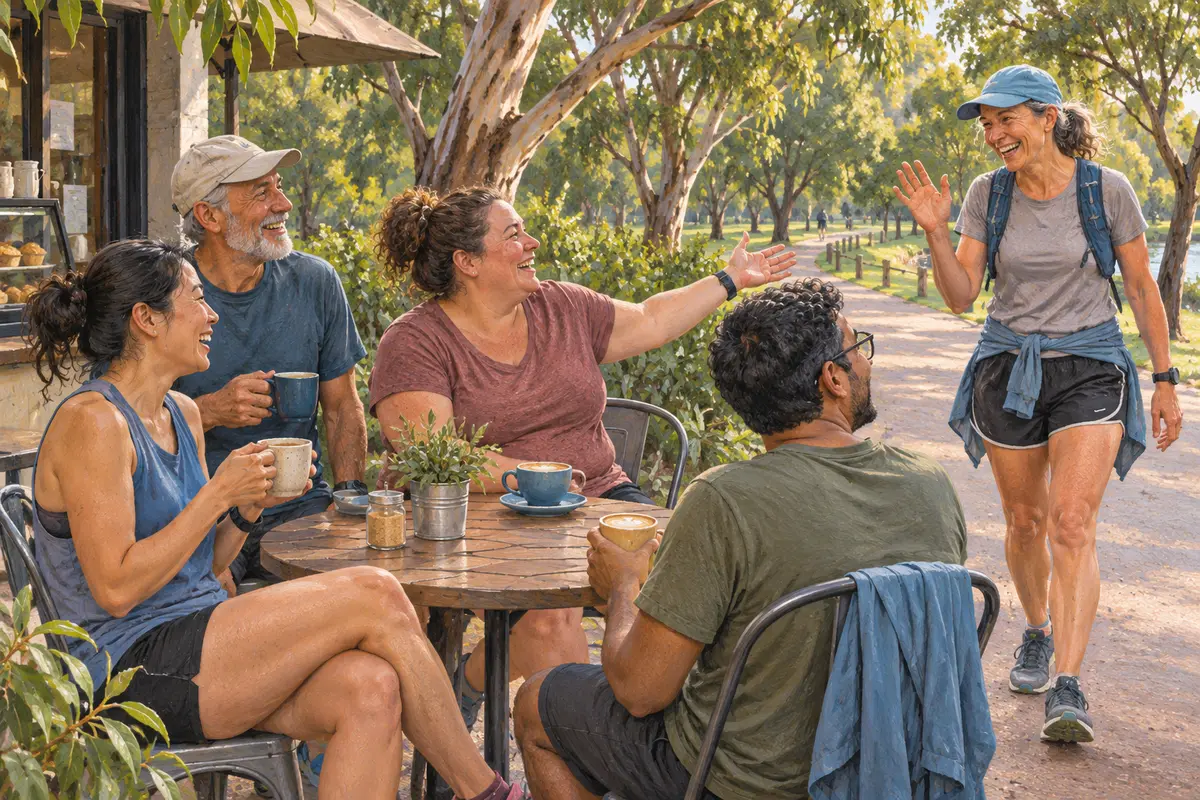
Depending on the location, we might see each other while we were out. But we would always end up having coffee together, and sometimes breakfast.
That gave us room to follow different plans and still have a regular catch-up. We didn’t all need the same distance on the calendar, or the same pace on the watch, to organise a Sunday morning together.
I think those examples are useful because “running with a group” can describe several different experiences.
You might want someone beside you for most of the run. You might enjoy a group that regularly comes back together. Or you might be quite happy doing your own session and meeting people afterwards.
It’s worth knowing which arrangement you’re being invited into.
A group can help by explaining what it actually does. Does someone stay at the back? Do runners loop around? Are walking breaks part of the session? Is the shared part the run itself, the coffee afterwards, or both?
Clear answers give people something useful to decide from. A particular session can have a pace or distance requirement too, provided that’s explained before someone turns up expecting something else.
Pathway’s Find the support you need offers some practical questions to ask when you’re looking for company or support.
For me, these groups show that there’s more than one way to make different paces work. What matters is having an arrangement people understand and can comfortably take part in.
And if the arrangement includes breakfast, it’s worth mentioning that in the invitation.